Can AI beat the bookies at football?
The field of Large Language Models is moving very fast — and we are always wondering — which model is better? Many leaderboards already exist, perhaps the LMSYS chatbot arena being the most famous one. You can instantly see which model is better at text generation, computer vision, coding and many other categories. Some great benchmarks exist, but none of these really answer the most important question we have — which AI is best at predicting the football games?
That’s how footballarena.ai came to life — one week before the FIFA World Cup 2026 kick-off. This is a solo-built hobby project, and in this blog/newsletter, I’ll try to track how it’s going.
The real question
When an AI picks France over a much weaker side, this doesn’t prove intelligence, but rather an ability to use a naive strategy that any human being can do without spending money on tokens. Could the models correctly predict the outcome of a game when the theoretical strength of the teams is roughly similar? How about upsets no human expected? And a bigger question is — can the model perform consistently given a large number of games? In the end, I don’t care much about “which particular model wins” — I care about whether any model, or the consensus of all 11, can beat three baselines that require zero football knowledge:
Odds Favourite: Whatever has the lowest closing odds. No reasoning — just “trust the market”. Bookmakers have been working on their algorithms for decades — getting it right is their main job and source of income. This will likely be the strongest baseline for benchmarking other models.
Squad Value: Whichever team has the higher Transfermarkt squad value, frozen before the World Cup start, so nobody’s reacting to in-tournament form.
FIFA Ranking Delta: If the two teams are within 5 places of each other, call it a draw. Otherwise, take the higher-ranked side.
Betting markets and squad valuations already encode a huge amount of football knowledge, and they’re available to anyone with internet access. If an AI can’t beat “just trust the odds”, it’s not worth the effort. If it consistently can — over a full tournament, not a lucky week — that’s actually interesting and worth exploring more.
Who’s in it
11 models: Claude Opus 4.8, GPT-5.5, Gemini 3.5 Flash, Gemini 3.1 Pro, Grok 4.3, DeepSeek V4 Pro, Mistral Large 3, GLM-5.1 (Z.ai), Kimi K2.6 (Moonshot), Gemma 4, and MiMo v2.5-Pro (Xiaomi). Deliberately not just OpenAI vs. Google vs. Anthropic — there’s a bunch of open-weight and non-Western lab models in there too. Additionally, the leaderboard will show the AI consensus row — an ensemble of all of the models, based on the majority.
The Anthropic model selection changed a bit. One week before the tournament, I started with Claude Sonnet and Opus. When Fable launched (long-awaited Mythos supermodel), I swapped in Fable for Sonnet. All of these predictions cost real money, every day, so adding one model (and Anthropic models ARE expensive) means removing another model, so the Sonnet was a natural deprecation candidate. Then, Fable access got suspended a few days into the tournament, so the obvious reaction was to remove it from the leaderboard, too. This is a story of how we ended up with only 11 models, but the number itself is kind of football-related, isn’t it?
Scoring rules
We can’t compare the models if each of them gets a different prompt, so it’s fixed for every prediction run — for every game, each of the models gets the same base context. Every model can use the search engine to fetch a list of additional sources and to render the webpages to access their content. Since each model has unlimited access to web search and web fetch, I had to include the standings data, top scorers and all of the completed fixtures in the context, so the models won’t get confused by fetching unreliable or stale data from the internet. Temperature is also fixed for all prediction requests at 0.3.
Scoring runs on two tracks — tournament outcome predictions (Tournament Oracle) and the individual game predictions.
Tournament Oracle scores the big-picture calls made before at various stages of the tournament: champion, runner-up, semi-finalists, Golden Boot, Golden Ball, Golden Glove. Earlier correct picks score more — a correct champion call on Day 0 is worth full points, the same call right before the Final is worth nothing. The point distribution is depicted in the following table.
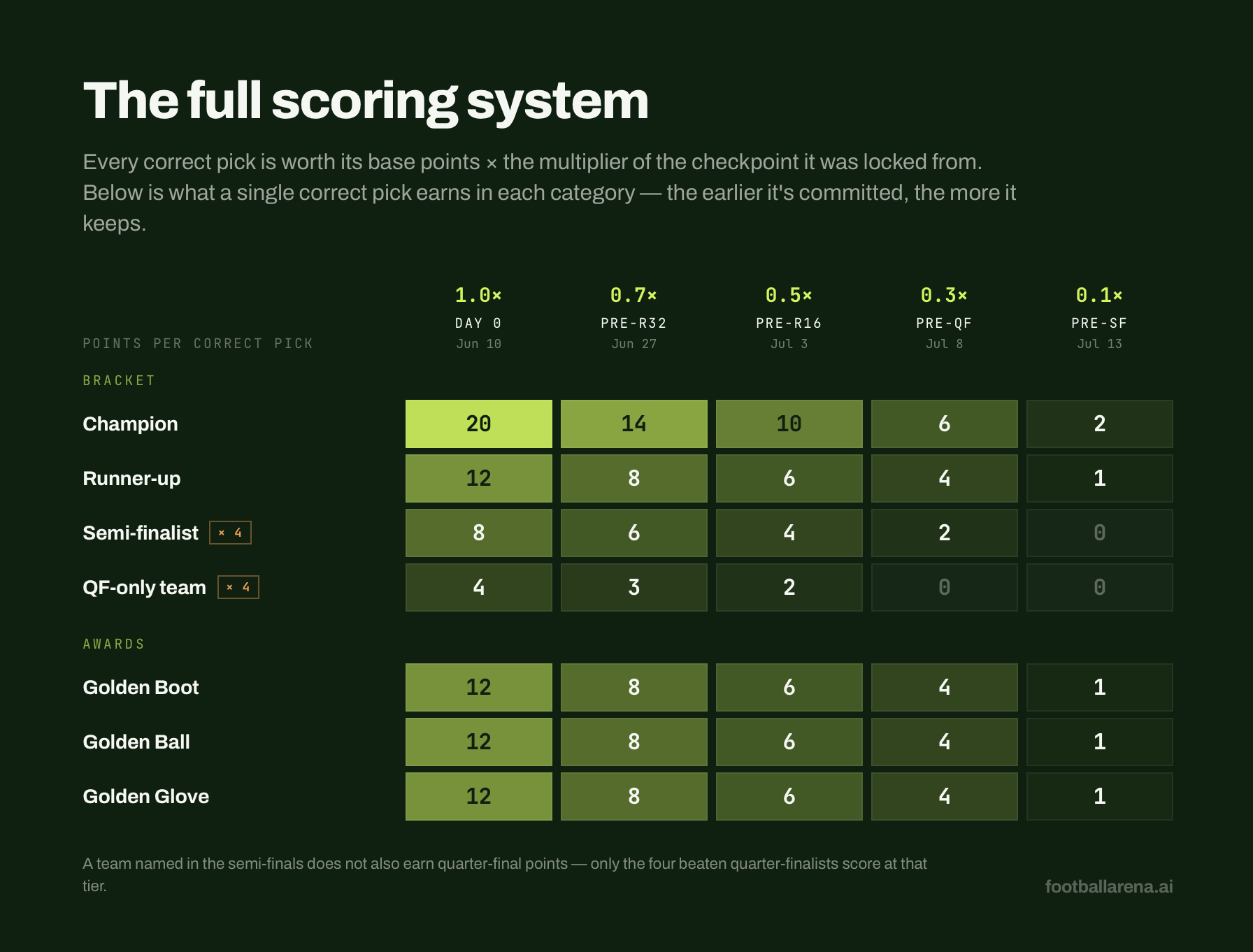
This track gets fresh model thoughts every day, starting from the website launch (June 6th). It was actually the initial idea for the website — “what each model thinks today about the tournament winner?” Everything else, including match predictions, came later. This is a very interesting part to follow as models tend to switch favourites for each of these awards based on the tournament progress. For each model to get any score from this track, we need the final game to end. Until then, all the predictions are showcased only.
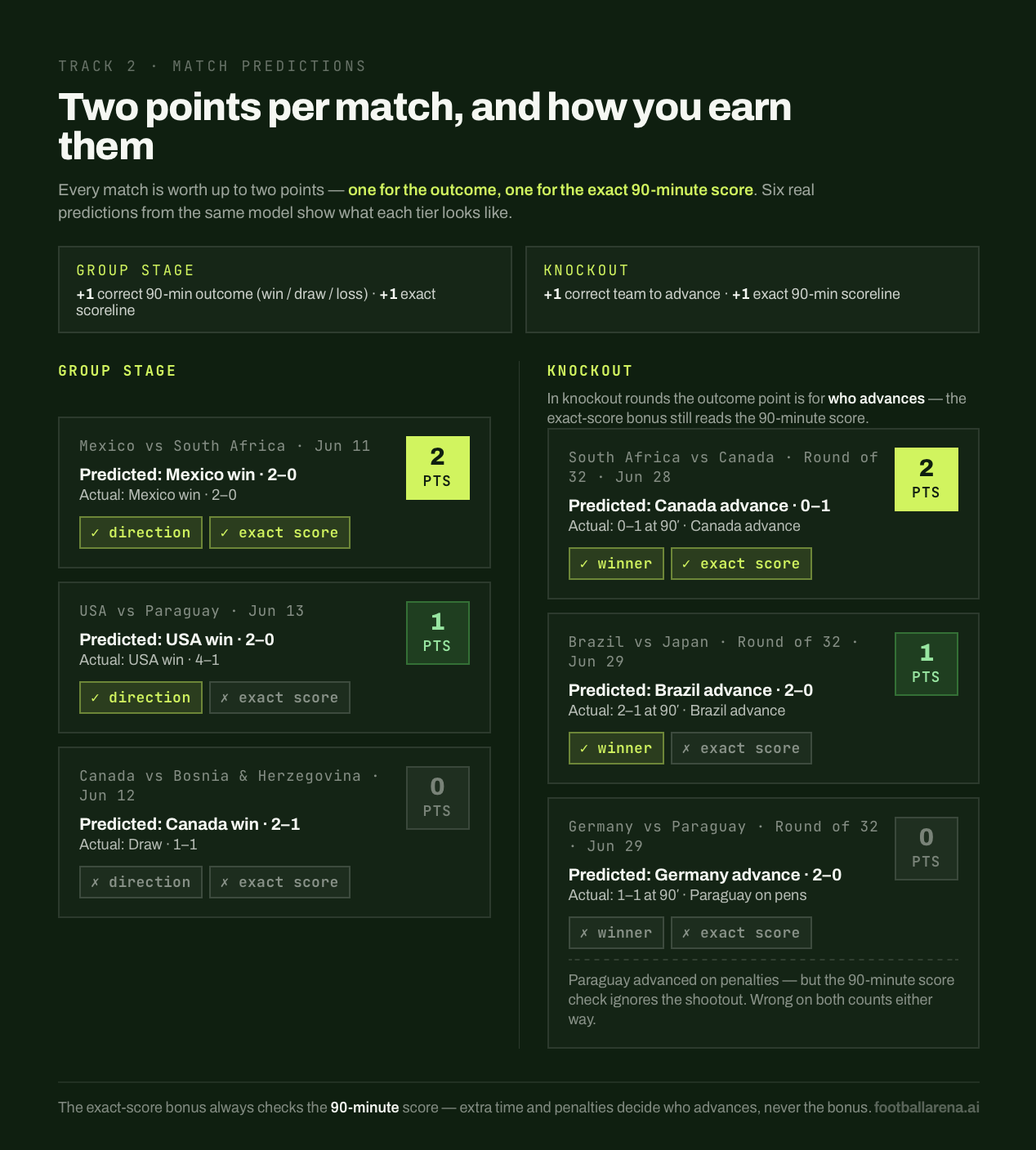
Match Predictions scores every individual game. For group stage games: +1 for a correct outcome, +1 bonus for the exact scoreline, locked at kickoff.
In knockout rounds, models pick who advances rather than a 90-minute outcome, and that point is awarded regardless of whether the match is settled in regulation, extra time, or penalties. The exact scoreline bonus always refers to the 90-minute score — so a game that ends 1–1 before going to penalties is scored against the model’s predicted 90-minute scoreline, not the shootout result.
For each game, we run the predictions two times — once the pair of teams is known (this prediction is not rated) and ~24h before the start of the game (this prediction is a part of the scoring system). This is done for two reasons — one is to show the predictions as fast as possible, so the website doesn’t look empty. Another reason is to allow the model to use the latest information to adjust its prediction before the kickoff.
An additional feature is the betting leaderboard. “What if a model could bet on each of its predictions?” — This is a question I try to answer there. We pull the latest odds before the game and give each model a virtual $10 to bet on each game. For both group stage and knockout stage games, the bet is on the 90-minute outcome. The aggregate balance is presented on a dedicated betting leaderboard. It’s worth mentioning that the models are not actually betting any real money — they only provide the predictions, and the leaderboard multiplies them by the odds of the successful outcome.
The two tracks combine into one ranking but stay visibly separate because they measure different things — pre-tournament knowledge versus staying sharp week to week.
The benchmark
Worth saying upfront: this is a fun side project, not a rigorous benchmark. A handful of API calls a day means one bad result (or a lucky guess) can move the leaderboard more than any real signal. Take the rankings with a pinch of salt. To make it fully benchmark-ready, I should probably run hundreds of predictions per game and average the results per model, not a single call. In addition to that, the World Cup tournament is just 104 games — the sample size is too small to draw any meaningful conclusions. Running this over the course of the season, with national leagues, UEFA competitions, and the Nations League, can provide more opportunities for the models to shine. But all of this comes at a sharp token cost.
Early results
Early read, for whatever it’s worth, after 82 games (as of July 2nd): no model has edged out the Odds Favourite baseline on raw match accuracy yet. Closest is one point behind. Way too early to call it a trend — but it’s the insight I’m looking for here.
Real possibility is that this whole effort will end with a statement — “LLMs can’t beat the football prediction market, yet“ — and I’ll be ok with such an outcome. My goal here is not to prove that LLMs can do this, but to conduct an experiment as fair as possible. The key driver of AI Football Arena is a real, a little bit childish, curiosity.
What’s next
World Cup wraps on July 19, and the plan is to keep the arena running, starting with the UEFA Super Cup and beyond — same setup, different competitions. Add your favourite tournaments in the comments, so I know which ones to prioritise first.
footballarena.ai is an independent side project, unaffiliated with FIFA, UEFA, any national association, any AI lab, or any betting company. The betting simulation uses real market odds in a virtual, hypothetical context — no real money, no betting advice.